Skip to content

We will discuss the working principle and applications of wire-wound potentiometers, including their mechanism of adjusting resistance through a rotating shaft, and their common application areas.
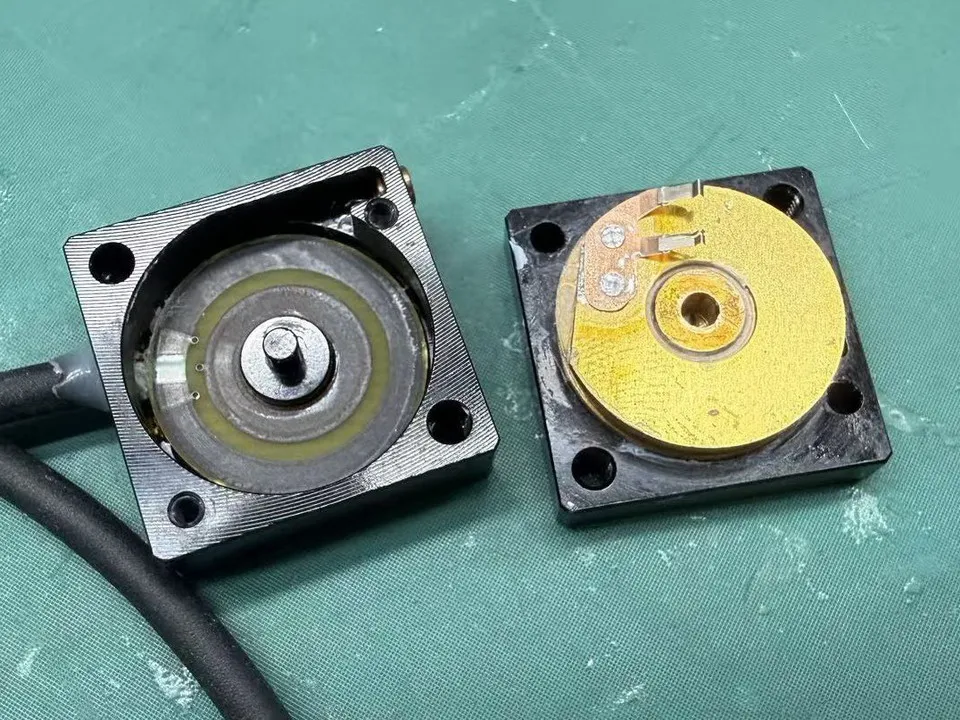
These are typical samples of wirewound potentiometers — eight in total, with two complete units and six partially disassembled to reveal the internal resistance windings and metal wiper assemblies, illustrating the internal structure and adjustment mechanism.
Wire-wound potentiometer is a special type of potentiometer with a power rating of 2W and an electrical lifespan ranging from 100,000 to 5 million cycles. Its linearity can be customized to a fixed value, typically ±0.05%, ±0.15%, or ±0.25%.
Windings and Brushes
The resistance wire (usually nichrome alloy) is wound around a ceramic or fiberglass core. It is wound into an arc shape using a specific winding machine, overlaid to form a spring-like state, ensuring that no short circuits occur between each winding. The rotating shaft drives the brush to move, and the brush head changes the length of the resistance wire at a specific point around the circumference, resulting in different resistance outputs.
Resistance Wire Material
The resistance wire is made from special materials with impedance and is drawn into fine wires of different diameters by a drawing machine. These fine wires are wound into specific shapes to achieve the desired resistance value and performance characteristics.
Common Models and Customization
Currently, the common models of wire-wound potentiometers include:
- 1-turn potentiometer (345° electrical angle)
- 3-turn potentiometer (345° electrical angle)
- 5-turn potentiometer (1800° electrical angle)
- 10-turn potentiometer (3600° electrical angle)
Custom potentiometers with special turns can also be made, requiring certain mold development costs to achieve potentiometers with more than 10 turns. These custom products are relatively more expensive than already formed products.
Application Scenarios
Due to its high precision and long lifespan, wire-wound potentiometers are widely used in applications requiring precise resistance adjustment, such as high-end audio equipment, measuring instruments, and industrial automation control.