Skip to content
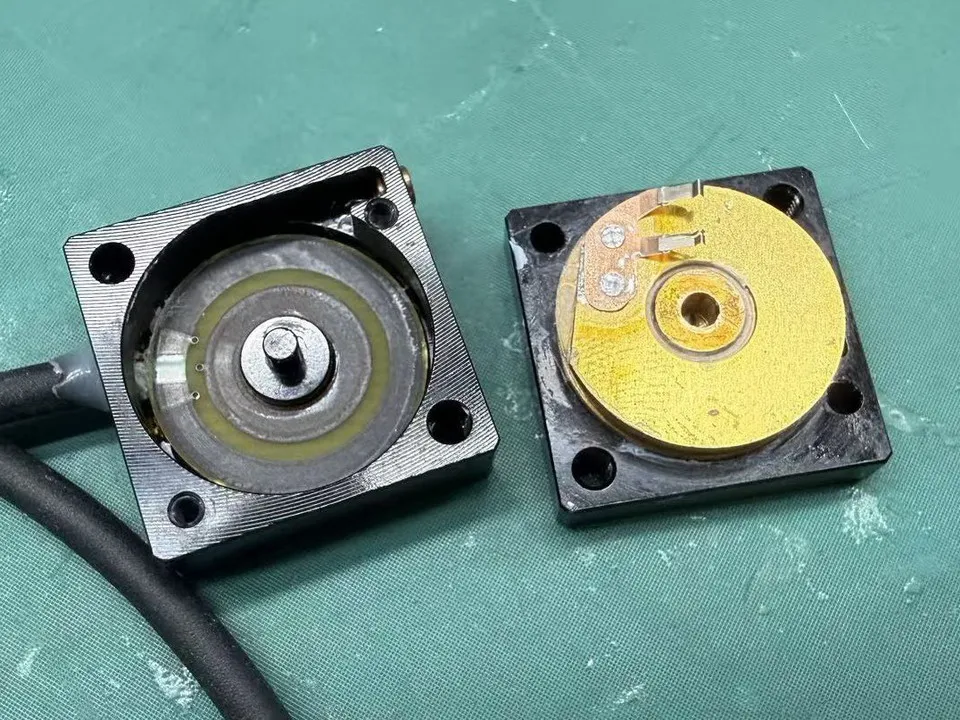
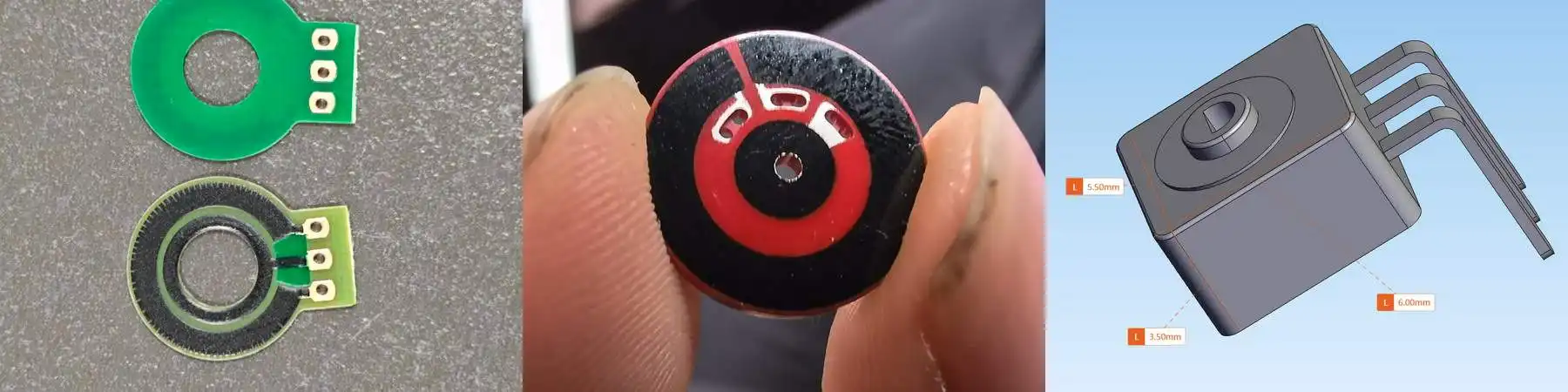
Disassembled string potentiometer showing the internal circular resistive track and wiper contact structure. This helps explain how a linear string movement is converted into rotary potentiometer feedback.
1. Introduction: The Difference Between a Potentiometer and a Sensor
In March and April this year, we received several interesting sample orders. They all came from our previously published potentiometer element blog page, but the customers were actually looking for position feedback sensors or related components.
In the next article, I will talk about a customer case involving a small hollow position sensor. That case became so detailed that even I felt a little dizzy by the end.
In fact, potentiometers and sensors are not completely separate things. Their basic principle can still be the same: a resistive track and a wiper form a voltage divider output. The real difference is the purpose of use. Some companies, such as TE, can even use potentiometer names to define certain sensor branches. I will mention this again later when discussing the TE M150.
1.1 Potentiometers Are More Related to Control
A potentiometer is more often used for adjustment or control. For example, it can be used to adjust volume, change signal level, set a circuit parameter, or work as a manual control component on a panel.
In these applications, users usually care about resistance value, size, operating feel, cost, and mounting method. The key question is: can this component adjust the circuit in a stable way?
1.2 Potentiometer Sensors Are More Related to Position Feedback
A potentiometer sensor has a different purpose. It helps a device know that a position has changed. This position can be a linear stroke or a rotary angle.
When a fixed voltage is applied to both ends of the resistive track, the position of the wiper decides the output voltage. Under a standard linear taper condition, if the wiper moves to 50% of the travel, the output voltage is also close to 50% of the input voltage in an ideal condition. For example, when the input is 5V and the wiper is in the middle position, the output may be close to 2.5V.
So, a potentiometer sensor is not a completely strange concept. It simply uses the voltage divider principle of a potentiometer in a position feedback application.
1.3 Potentiometer vs Potentiometer Sensor-table
| Item | Standard Potentiometer | Potentiometer Sensor |
|---|---|---|
| Main purpose | Manual adjustment or signal control | Position feedback |
| Main concern | Resistance value, size, feel, cost | Output signal, linearity, life, stability |
| Typical use | Volume control, panel adjustment, calibration | Linear stroke, rotary angle, actuator position feedback |
| Key question | Can it adjust the circuit? | Can it report position reliably? |
From the table above, we can see that a potentiometer sensor is not a completely unfamiliar concept. It uses the voltage divider principle of a potentiometer in a position feedback application.
2. String Potentiometer, Linear Potentiometer Position Sensor, and Standard Rotary Angle Sensor
If we only look at the application, both a string potentiometer and a linear potentiometer position sensor can be used for linear displacement measurement. But from a manufacturing point of view, their working structures are not the same.
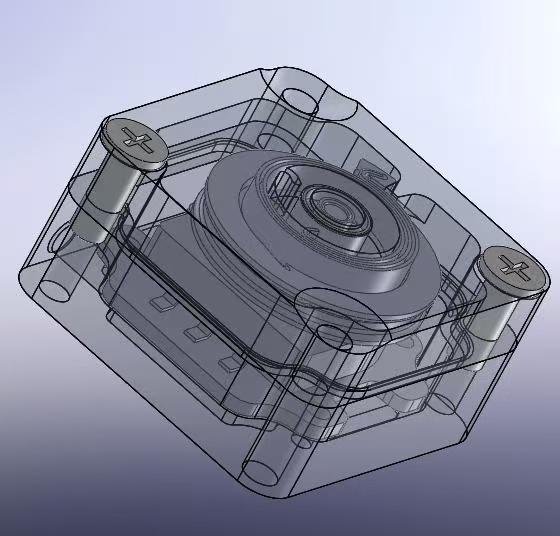
Simply speaking: a string potentiometer is “linear movement outside, rotary movement inside.” A linear potentiometer position sensor is “linear movement outside, linear movement inside.” A standard rotary angle sensor is “rotary movement outside, rotary movement inside.”
2.1 Differences Between Three Position Feedback Products-table
| Item | String Potentiometer | Linear Potentiometer Position Sensor | Standard Rotary Angle Sensor |
|---|---|---|---|
| Measured target | Linear stroke or linear distance | Linear stroke or linear position | Rotary angle |
| External movement | String is pulled in a straight line | Rod or moving part travels in a straight line | Shaft rotates directly |
| Internal conversion | Linear movement is converted into rotation | Linear movement acts directly on a straight resistive track | Rotation is measured directly |
| Resistive element | Often a circular potentiometer element inside | Usually a straight resistive track | Circular potentiometer element |
| Output signal | Voltage divider output related to string position | Voltage divider output related to linear position | Voltage divider output related to shaft angle |
| Main value | Measures linear distance in compact space | Directly reports linear position with a clear structure | Measures angle directly |
| Main limitation | Wheel, string return, and angle conversion increase manufacturing difficulty | Longer stroke usually requires a longer body | Mainly suitable for direct rotary position feedback |
| Key concern | String return, wheel diameter, electrical angle, cycle life | Linearity, repeatability, mounting stability, life | Shaft fit, angle range, linearity, mounting |
This table puts the three product types together. For readers, it is faster to understand the basic relationship from the table first. These products may all be related to position feedback, but their measured target, internal structure, and manufacturing difficulty are different.
2.2 String Potentiometer: Linear Movement Outside, Rotary Movement Inside
A string potentiometer is also often called a string displacement sensor.
For example, when the string is pulled out by 10 mm, 20 mm, or 30 mm, the product needs to convert this linear travel into a corresponding output signal. From the user’s point of view, it is a linear displacement sensor. The customer cares about how far the string is pulled out and whether the output voltage can correctly represent that position.
But the key point of a string potentiometer is not “there is a string.”
The real key is: it converts external linear movement into internal rotary movement, and then uses the potentiometer voltage divider principle to output a position signal.
The value of this structure is that it does not need to place a full straight resistive track along the travel direction. This is very important for applications with limited mounting space.
2.3 Linear Potentiometer Position Sensor: Direct Position Feedback Along a Straight Resistive Track
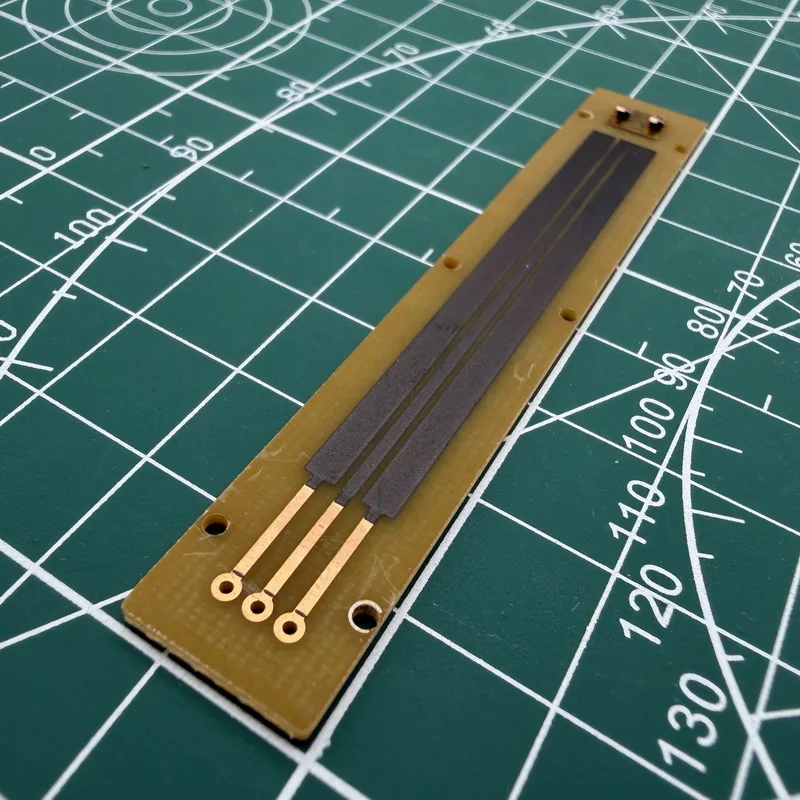
A linear potentiometer position sensor is also a linear position feedback product, but its structure is more direct. It usually uses a straight resistive track and a wiper moving with the mechanical part to convert mechanical position into voltage output. When the wiper moves to different positions, the output voltage changes accordingly.
This type of product is suitable for hydraulic equipment, injection molding machines, automation slides, actuators, or other equipment that needs to know the position of linear movement. Its advantage is that the measuring path is clear, and the relationship between position and output is easy to understand. If a customer needs to measure a 50 mm, 100 mm, or 500 mm stroke, a linear potentiometer position sensor can be arranged directly along the travel direction.
But it also has an obvious limitation: the longer the measuring stroke is, the longer the product body usually needs to be.
If the equipment has enough straight mounting space, this is not a problem. But if the space is small, a normal straight structure may be limited. This is where a string potentiometer becomes useful. It does not need to spread the full resistive track along the stroke direction. Instead, it uses a string and reel to convert the linear distance into an internal rotary angle.
2.4 Standard Rotary Angle Sensor: Direct Measurement of Rotary Angle
A standard rotary angle sensor measures angle directly. For example, when the shaft rotates by 30°, 90°, 300°, or 350°, the sensor outputs a corresponding voltage signal.
Its external movement is rotation, and the internal wiper also moves around a circular resistive track. From the structural point of view, the measured target and the internal movement are consistent.
This is different from a string potentiometer. A string potentiometer appears to measure linear displacement from the outside, but inside it includes more mechanical conversion and potentiometer angle feedback. This means the assembly accuracy requirement is usually higher.
3. From a Manufacturer’s Point of View: Looking at the TE M150
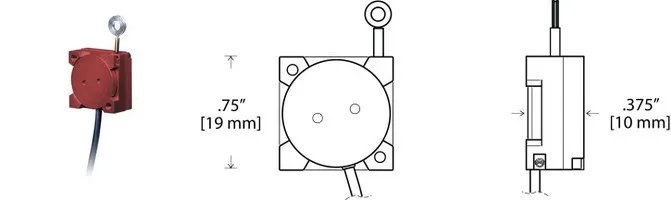
Outline dimensions of the TE M150 string potentiometer, showing its compact body size and short-stroke position feedback structure.
3.1 Why I Choose the TE M150 as an Example
We choose the TE M150 as an example for two main reasons.
First, based on public information, the M150 is positioned as the smallest string potentiometer, and its life can reach 5 million cycles. It is suitable for aerospace and automotive test applications where space is limited.
Second, we have always treated companies such as TE, Bourns, and Vishay as brands to learn from and catch up with. Here I also want to say something honestly. Readers, please do not laugh at us: every time an inch-based size is converted into a metric size, the manufacturing accuracy becomes more difficult to handle.
This is because the maximum and minimum values in inch dimensions often cannot match the integer metric sizes we are used to. In the end, the tolerance range may have to be narrowed. For small position sensors, this directly increases manufacturing and assembly difficulty.
3.2 M150 Product Characteristics Based on Public Parameters-table
Several parameters of products like the M150 are worth looking at together.
| Parameter | TE M150 Example | Manufacturing Meaning |
|---|---|---|
| Size | 19 mm square body, 10 mm thickness, 1.5 inch travel length, about 38 mm | Linear travel is packed into a compact body |
| Output signal | Voltage divider output | It still uses potentiometer signal logic |
| Sensor type | Conductive plastic precision potentiometer | Smooth output and cycle life are important |
| Accuracy | ±1% full stroke | The output is judged as position feedback |
| Application direction | Aerospace and automotive space-critical test applications | It is designed for compact position measurement, not control |
Two points are especially important.
First, its output is a voltage divider output. This means its signal logic is still based on the potentiometer voltage divider principle. Second, its internal sensing part uses a conductive plastic precision potentiometer. This shows that in a small-size and high-cycle application, the internal resistive element and wiper structure are very important.
3.3 Manufacturing Challenges of a Small String Potentiometer-table
The manufacturing challenge of a small string potentiometer is not only about making the housing small. The real difficulty is handling the reel spring, the effective electrical angle of the conductive plastic resistive element, linearity, and assembly tolerance within a limited space.
| Manufacturing challenge | What it means | Impact on the product |
|---|---|---|
| Reel spring | The reel spring must provide stable return force in limited space | Unstable return affects zero position, consistency, and repeatability |
| High cycle life | For 5 million cycles or more, the return system must remain stable after long repeated movement | Wear, stress relaxation, or force change can affect the final output |
| Effective electrical angle | A larger effective electrical angle can support a longer travel range under the same accuracy requirement | Too small an angle gives coarse output change; too large an angle creates terminal and stability issues on a small element |
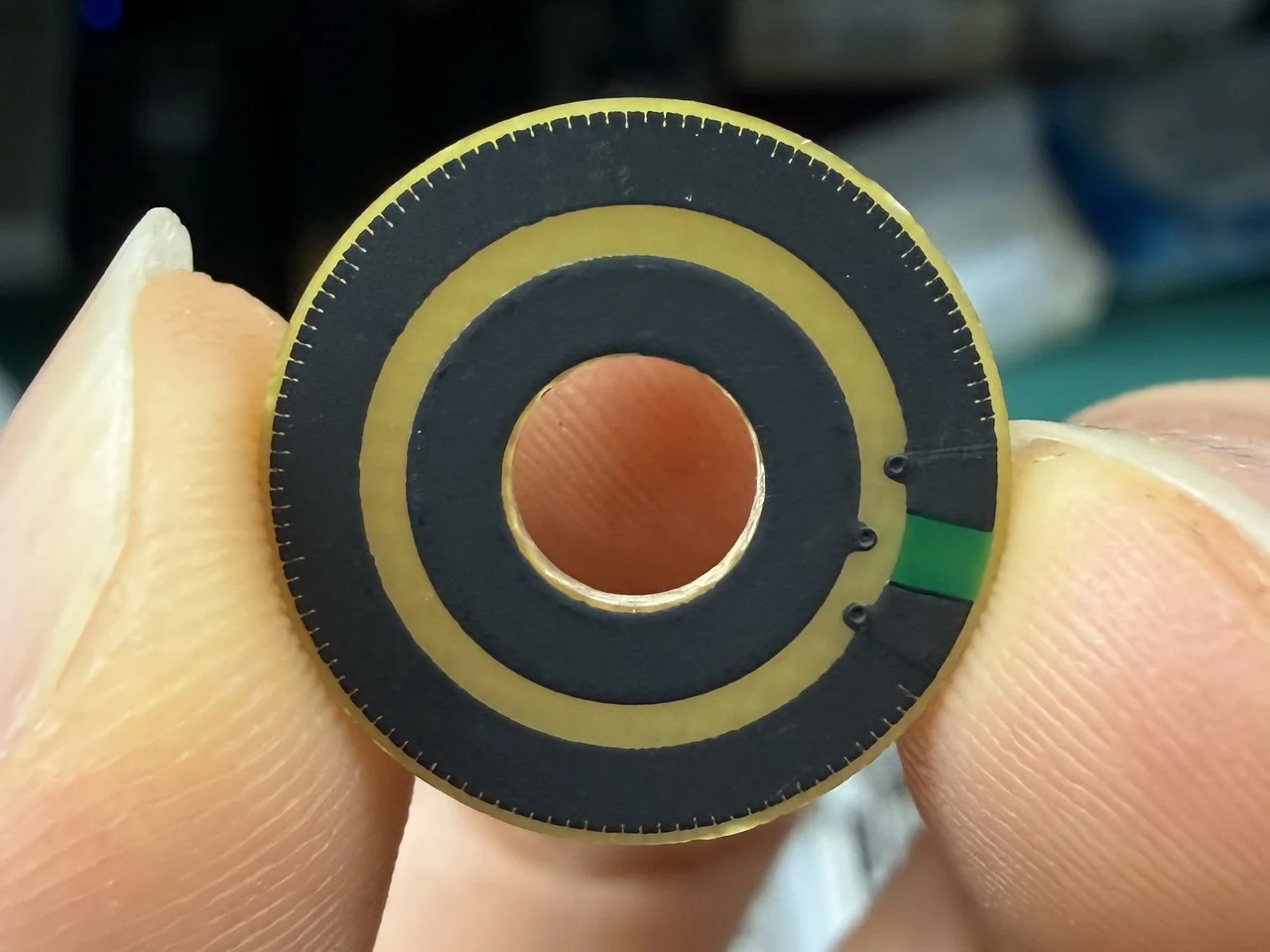
| Small conductive plastic resistive element | In a body around 19 mm, the internal circular conductive plastic element may only be about 15–17 mm OD | Track width, terminal area, and wiper contact position affect each other |
| Linearity | Linearity affects measurement accuracy; a smaller value is usually better | A smaller circular track has less correction space and makes laser trimming more difficult |
| Accuracy understanding | Full-stroke accuracy and linearity are related, but they are not exactly the same definition | Better linearity can reduce position error, but final accuracy is also affected by assembly and structure |
| Assembly tolerance | Even if each part meets its requirement, assembly tolerance still exists | Small deviations among the reel, shaft, string, spring, wiper, resistive element, and housing affect output consistency, return position, and repeatability |
So, the real difficulty of a small string potentiometer is not one single part, but the overall stability after all parts are assembled.
The reel spring, resistive element, wiper, and housing may look like separate parts, but together they decide the output curve, return position, and service life. Especially in a small structure, a single dimensional deviation may not look serious, but after several deviations are stacked together, the final position feedback performance can be affected.
4. Final Notes
Strong companies can really define products in their own way. Products such as linear potentiometers and string potentiometers may look like potentiometers, but in many cases, companies such as TE, Bourns, and Vishay have already placed them into the sensor system. They still use the voltage divider principle of potentiometers, so terms such as Potentiometer Sensor also appear.
NOLELC is still young, and we still need time to keep growing.
For us, these products are not about simply copying the appearance. We need to understand the internal structure, material route, effective electrical angle, linearity, and assembly tolerance. Only after these points are understood can we talk about replacement, customization, sampling, and mass production. Otherwise, we may only stay at the stage of “it looks similar.”