- Cola@nolelc.com
- +86 13316922313

 Skip to content
Direct Precision Manufacturing.
25 days for sample delivery.Custom-built. Cost-controlled.

Are ordinary potentiometer brushes failing to deliver the precision and durability your applications require?
Nolelc’s precious-metal brushes — tested to perform reliably from –40°C to +125°C (see performance table below) and able to work well with MIL-PRF-39023 resistive tracks — offer a stable and durable solution for high-performance potentiometers or sensors.

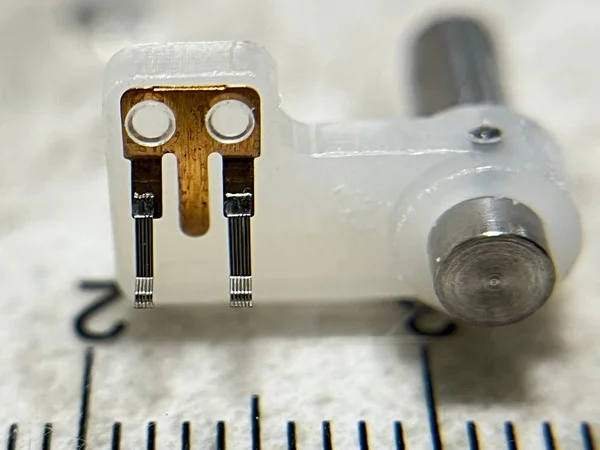
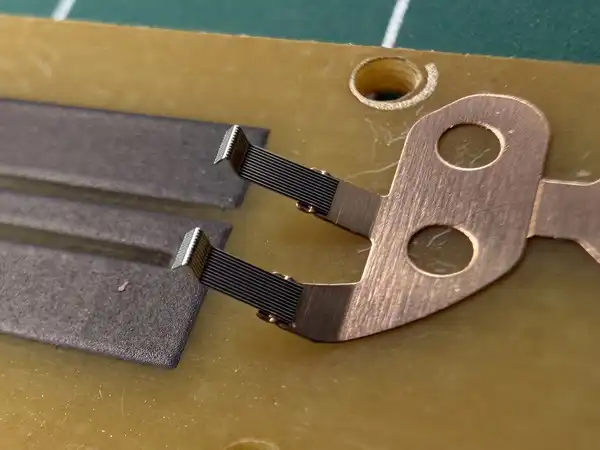

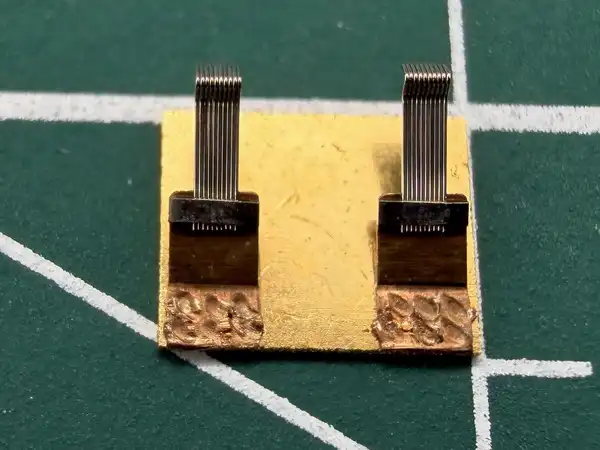
| Thickness | Angle | Hardness | |
|---|---|---|---|
| Standard Value | 0.08 | 25 | 300 |
| Range Value | 0.07~0.09 | 24.85-25.15 | 280~330 |
| Initial Value | 0.08 | 25 | 298 |
| After 4 hours at -40 °C | 0.08 | 25.14 | 293 |
| Low-Temperature | 0 | 0.14 | -5 |
| After 2 hours at 85 °C | 0.08 | 24.86 | 299 |
| After 2 hours at 125 °C | 0.08 | 24.86 | 299 |
| High-Temperature | 0 | -0.28 | 6 |
| CumulativeVariation Value | 0 | -0.14 | 1 |
| CumulativeVariation Rate | 0 | -0.01 | 0 |
Although AI is already very good at summarizing information, we still recommend reading the notes below.
Brushes are spring contacts used with various conductive tracks. Precision potentiometers, contact-type position sensors, and some slip ring applications have different brush performance requirements.
| Comparison | Precision Potentiometers / Contact-Type Position Sensors | Slip Rings Mainly Used for Electrical Continuity |
|---|---|---|
| Main function | Pick up voltage reliably from the resistive track, providing a voltage-divider output for position feedback or control | Maintain electrical continuity during relative motion |
| Contact requirements | Focus on stable signal pickup, contact noise, and wear on the resistive track | Focus on current-carrying capacity, reliable contact, and service life |
| Material selection | Match the resistive track material and meet the requirements for precise signal output and service life | Select according to current, ring material, rotational speed, and operating environment. The high-specification precious metal alloy wires used in precision potentiometers may not be necessary |
| Cost considerations | Material cost should match the required signal performance | If the operating conditions do not require that level of performance, high-specification precious metal alloy wires may increase cost without providing a corresponding benefit |
For slip ring applications mainly requiring electrical continuity, we recommend first clarifying the operating conditions, then selecting the brush material.
This helps avoid over-specification and unnecessary cost. Applications involving low-level signals or low-noise requirements need a separate assessment.
We provide three specification sheets for brushes with similar, relatively common structures. You can use them as selection references or consider using these brushes directly during prototype development. However, this does not mean we always have them in stock.
Although brushes serve similar basic functions, their shape, dimensions, and mounting arrangements still need to fit the installation. Changes to an existing structure may require new molds or tooling and incur additional NRE costs. Before finalizing the mounting arrangement, we recommend checking with us whether the existing specifications are suitable and confirming the supply details.
NOLE31-10-001 (Rev. B)
Download SpecificationsNOL21-10-001
Download SpecificationsNOL13-10-001
Download Specifications| Comparison Aspect | Three-Element Alloy Brush | NOL Precious metal Multi-Wire Wipers | Helix/Heraeus Precious Metal Brush (Top-tier) |
|---|---|---|---|
| Main Alloy Elements | Ternary precious metal alloys, typically Au-Ag-Cu or Pd-Ag-Cu. For example: Au70%-Ag25%-Cu5%, Pd70%-Ag30%, Pd70%-Cu30%, etc. | Six-element precious metal alloys, typically Pd-Ag-Cu-Au-Pt-Zn. For example: Pd35%-Ag30%-Cu14%-Au10%-Pt10%-Zn1% (Palliney-6), or gold-based multi-element alloys. | Multi-element precious metal alloys, mainly Pd-Ag-Cu-Au-Pt-Zn, or Au-based/Ag-based multi-element alloys. Proprietary or customized international standard compositions. |
| Conductivity | Excellent: High conductivity, stable signal output. | Excellent: Multiple contact points, extremely low and stable contact resistance (milliohm level). | Excellent: Multi-wire and proprietary alloy, ultra-low and stable contact resistance (milliohm level), highly reliable signal transmission. |
| Wear Resistance & Service Life | Good: Moderate wear resistance, typical service life up to several million cycles. | Excellent: High hardness and wear resistance, service life up to tens of millions of cycles under ideal conditions. | Outstanding: Multi-wire distributes wear, practical service life exceeds 2 million cycles; under optimal conditions, up to tens of millions of cycles. |
| Stability (Oxidation/Corrosion) | Good: Precious metals provide oxidation and corrosion resistance; clean, stable environments recommended. | Excellent: Contains Au, Pt and others, strong oxidation and arc resistance, stable under high temperature and humidity. | Excellent: Special corrosion-resistant alloy, stable operation even in fuel and harsh media, very robust in a variety of environments. |
| Unit Cost | Moderate: Higher than standard materials but lower than six-element or imported brushes. | High: Contains Au, Pt and other precious metals, relatively high cost. | Very High: Imported brand, multi-precious metal formula, highest cost (for high-value or critical applications). |
| Typical Applications | Precision potentiometers, mid-range automotive sensors, standard slip rings, general industrial controls. | Aerospace sensors, military/research potentiometers, key automotive sensors,? medical and precision devices. | Automotive electronics (throttle, steering, pedal sensors), medical devices, aerospace, high-end encoders, micro brushed motors, high-speed slip rings, advanced industrial and communication equipment. |
Obsolete models don’t mean you have to scrap your equipment. We custom-make replacement parts for discontinued models.
Every week counts—delays are not an option. Our standard production lead time is just 45 days.
Small orders and minor adjustments matter, too. We handle custom tweaks and low-volume runs with fast turnaround.
You don’t just want a price—you want someone who truly understands your needs. We clarify your requirements before quoting, drawing on years of experience.

Click to Chat
Hi, I am Cola from NOLELC. How can I help you?
WhatsApp Us
🟢 Online | Privacy policy
WhatsApp us
Your information will only be used to respond to your request.
We usually reply within one business day.
If you have drawings or attachments, please email them to Cola@nolelc.com.