Skip to content
Written for engineers working on drones, robots, and similar prototype products
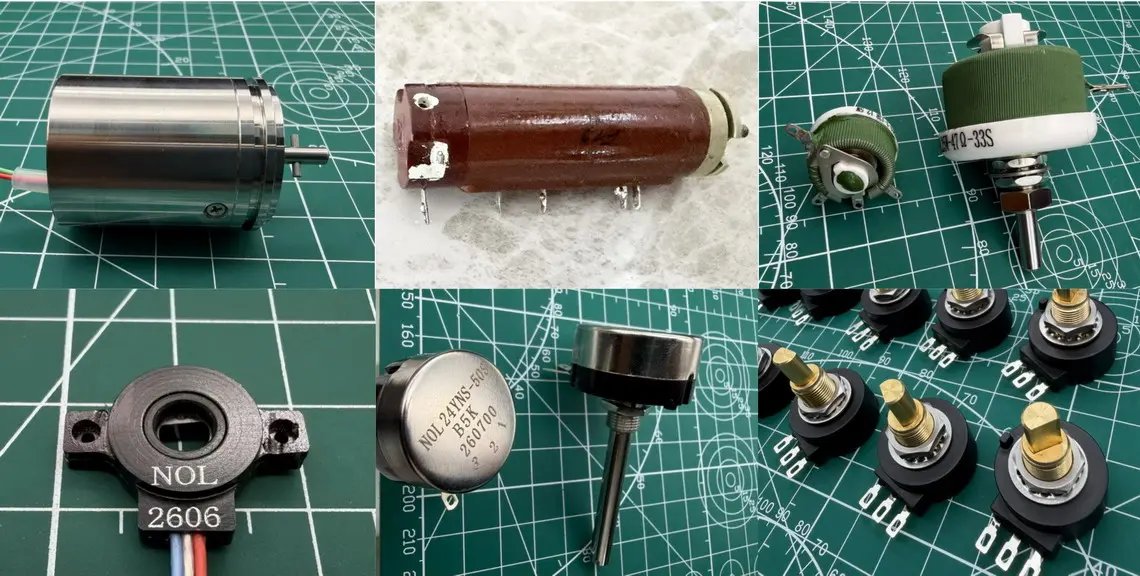
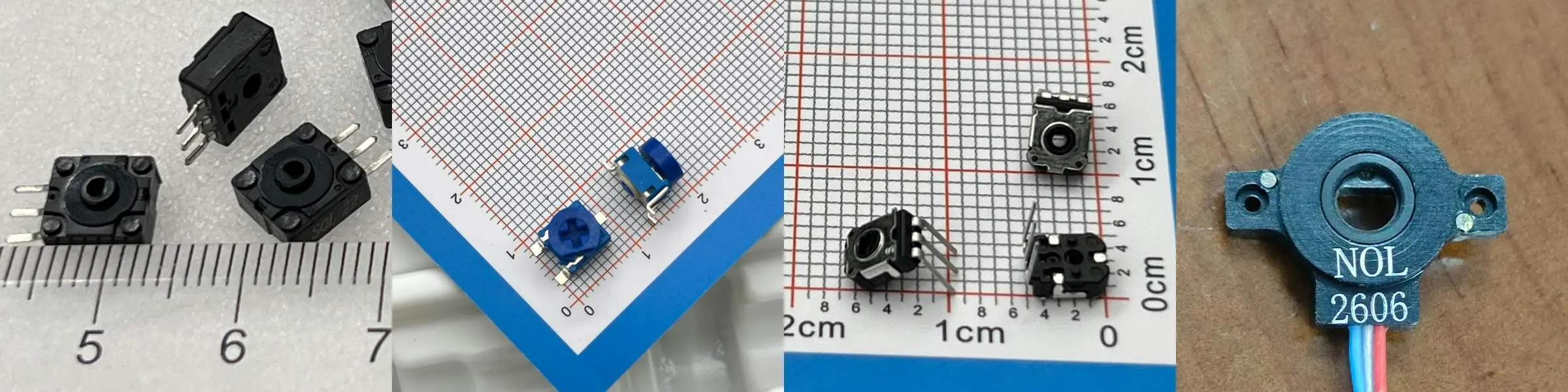
First, please note that all the products described below are contact-type components. From left to right, they are:
- Through-hole trimmer - you can see its pins in the picture
- SMD trimmer - you can see its surface-mount terminals in the picture
- Miniature potentiometer / not-so-useful miniature sensor / miniature encoder
- High-performance miniature angle sensor with a 10 mm core diameter
Introduction
Over the past two months, these tiny components have really given me a headache.
The four small components above still look fairly easy to tell apart. So let us make a simple choice. If the product is planned for a drone or a robot, which one would you choose?
I believe most people would choose the last one. But before a prototype is actually turned into a real product, some engineers may be misled by the third small component. Later in this article, I will simply call it a miniature potentiometer.
Here I want to explain why it can have three names. This type of angle sensor can only output standard values at certain specific angles. So in some cases, people may describe it as three different types of products. And because this product exists, it has caused a lot of confusion for engineers who are trying to bring prototypes into real production.
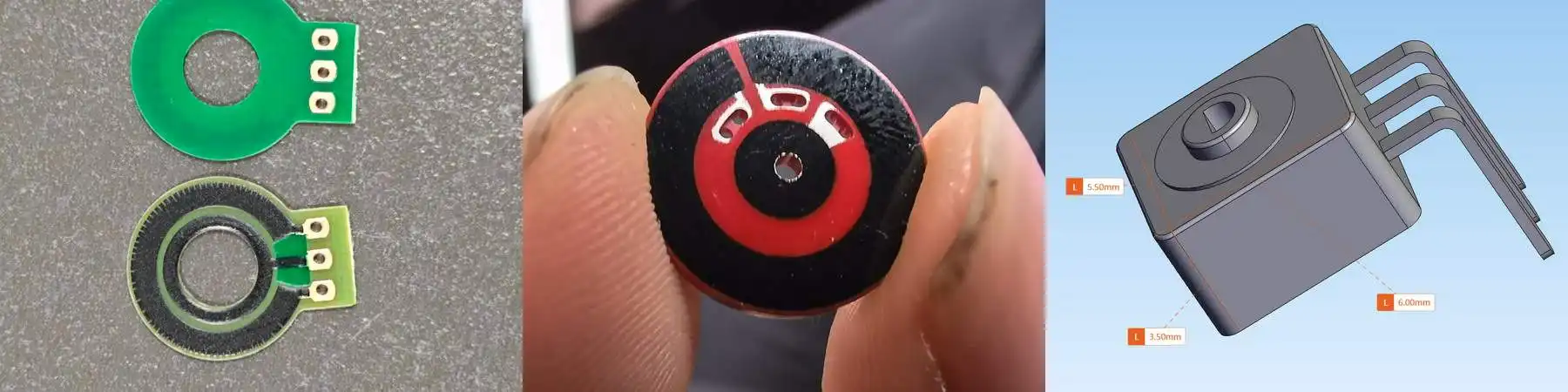
When you ask about this type of product in the early stage, you may find that such a small sensor seems to exist. Then you may think you only need to make the space slightly larger. If you look closely at the picture, this small part is about 5 mm. Many engineers may think 6 mm is enough. But this small misunderstanding can become a serious problem later.
For an angle sensor with a 10 mm core shaft area, I do not know whether this is already the limit for major brands. But it is indeed our current limit.
Also, if your project involves an angle sensor requirement, you can skip Sections 2, 3, and 4 and go directly to Section 5. That is the key part. Alternatively, you can go directly to “Why Are Contact-Type High-Performance Angle Sensors Usually Larger Than 10 mm in Diameter? — Written for Drone and Robotics Engineers, Part 2.”
1. First, use a table to clarify several names
Let us first use a table to separate several names that are often confused.
| Product Type | Common English Terms | More Accurate Understanding | Main Use |
|---|---|---|---|
| Trimmer | Trimmer / Trimmer Resistor / Trimmer Potentiometer / Trimpot | A small adjustable component used for circuit calibration. Usually adjusted once and rarely moved again | Calibration, compensation, setting reference values |
| Through-hole trimmer | Trimmer Resistors - Through Hole / Through-Hole Trimmers | A trimmer soldered to the PCB through pins | Board-level calibration, manual adjustment, easier maintenance |
| SMD trimmer | Trimmer Resistors - SMD / SMD Trimmers | A trimmer suitable for surface-mount assembly | Automatic PCB mounting, space saving, reflow soldering |
| Miniature potentiometer | Miniature Potentiometer / Micro Potentiometer | A smaller potentiometer that still works as a potentiometer. It may be adjusted repeatedly by hand or by a mechanism | Small device adjustment, knob control, mechanical adjustment |
| Miniature angle sensor | Miniature Angle Sensor | A small sensor that converts angular movement into voltage or signal output | Position detection, angle feedback, control systems |
With this table, we can first make the names and basic functions clearer.
2. First understand trimmer: it is not a normal knob potentiometer
In English component classifications, trimmer is a very common word. It can appear in many different names, such as:
- Trimmer Resistor
- Trimmer Potentiometer
- Trimming Potentiometer
- SMD Trimmer
- Through-Hole Trimmer
- Trimpot
The core meaning of these terms is very similar. They usually refer to a small adjustable component used for internal circuit calibration, compensation, or parameter setting.
There is also an easy-to-miss historical background.
Trimpot was originally a trademark name used and promoted by brands such as Bourns. Later, trimmer, trimming potentiometer, and trimmer resistor gradually became more general category names in the industry.
In this article, I will call this whole type of product: trimmer.
Its main purpose is not to “let the user rotate it every day.” Instead, it is used for:
- Circuit calibration.
- Parameter compensation.
- Setting reference values.
- Usually adjusted once and rarely moved again.
This point is very important. It determines the real difference between a trimmer, a miniature potentiometer, and a miniature angle sensor.
3. Trimmers can be divided into two types: through-hole and SMD
Trimmers themselves can be further divided by mounting method:
- Through-hole trimmers
- SMD trimmers
Their functions are similar. Both are used for internal circuit adjustment. But their assembly methods and application conditions are different.
3.1 Through-hole trimmers: better for through-hole soldering and manual adjustment
A through-hole trimmer can be written in English as:
- Trimmer Resistors - Through Hole
- Through-Hole Trimmers
It uses pins that pass through the PCB and are then soldered in place. The structure is relatively easy to understand, and manual soldering, maintenance, and adjustment are all more convenient.
Through-hole trimmers are still common in some power modules, control boards, instrument circuits, and sensor signal conditioning boards. For example, when a customer needs to adjust zero position, gain, reference voltage, or a certain threshold, a through-hole trimmer can provide a simple and direct adjustment method.
Its advantages are:
- Relatively firm installation.
- Easy manual adjustment.
- Easier to inspect and replace during maintenance.
It is friendly to some traditional PCBs or small-batch products. But it also has clear limitations. If the customer’s PCB has a height limit, or the entire board already uses an automatic SMD assembly process, a through-hole trimmer may not be suitable. It needs holes, takes space on both the top and back sides of the PCB, and is not as suitable for high-speed automatic assembly as SMD components.
A through-hole trimmer is not an outdated product. It is simply more suitable for certain applications that require a specific assembly method, easier maintenance, or stronger mounting structure.
3.2 SMD trimmers: the key point is SMD assembly
An SMD trimmer can be classified in English as:
- Trimmer Resistors - SMD
- SMD Trimmers
Its core point is not that it is “more advanced” than a through-hole trimmer. The real point is that it is more suitable for surface-mount assembly.
Customers usually choose SMD trimmers for several reasons:
- Limited PCB space.
- Limited product height.
- Automatic SMT production line.
- Need to reduce through-hole assembly steps.
- Need a more compact overall assembly.
Based on public brand data and distributor platform classifications, I especially put SMD trimmers and through-hole trimmers together for comparison.
My conclusion is: in SMD trimmer data, size, soldering process, adjustment direction, sealing, and packaging method are often emphasized more. In through-hole trimmer data, mounting type and adjustment convenience are more likely to be noticed by buyers.
This is not just a difference in name. It reflects a different assembly logic.
4. Miniature potentiometer: as explained above, it is very easy to confuse during early inquiry
Trimmers and miniature potentiometers are often mixed together. Both may be small, both may have three terminals, and both may use a wiper moving on a resistive element to change the resistance relationship.
But from the actual use point of view, they are not the same purchasing logic.
A trimmer is usually:
- Mounted on a PCB.
- Adjusted with a screwdriver.
- Used for calibration or compensation.
- Rarely moved after adjustment.
- More focused on setting stability and soldering suitability.
A miniature potentiometer is usually:
- May have a shaft or knob structure.
- May be repeatedly operated by hand.
- May also move with a small mechanism.
- More focused on feel, life, mechanical structure, and output stability.
So a miniature potentiometer should not be simply understood as a “larger trimmer.” And a trimmer should not be simply understood as a “small potentiometer.”
Their difference is not only size. It is also about operating cycles and how the part is used.
If a component is only adjusted once during production and then basically does not move, it is more like a trimmer.
If a component will be repeatedly adjusted by the user, or will keep moving inside a device, it is closer to a miniature potentiometer.
This judgment should come before resistance value.
Because the same 10K component can be an SMD trimmer, a through-hole trimmer, or a miniature rotary potentiometer.
5. Miniature angle sensor: angle feedback
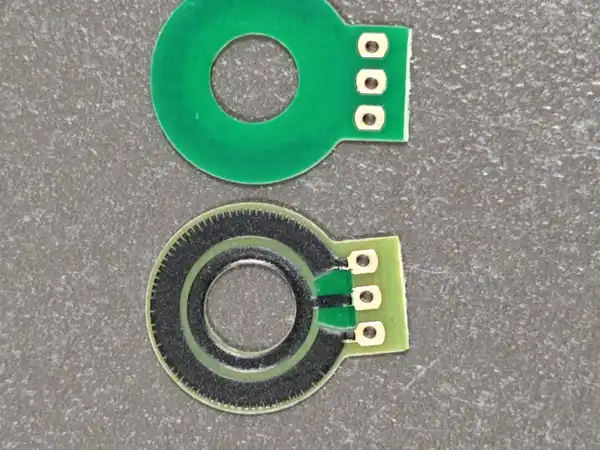
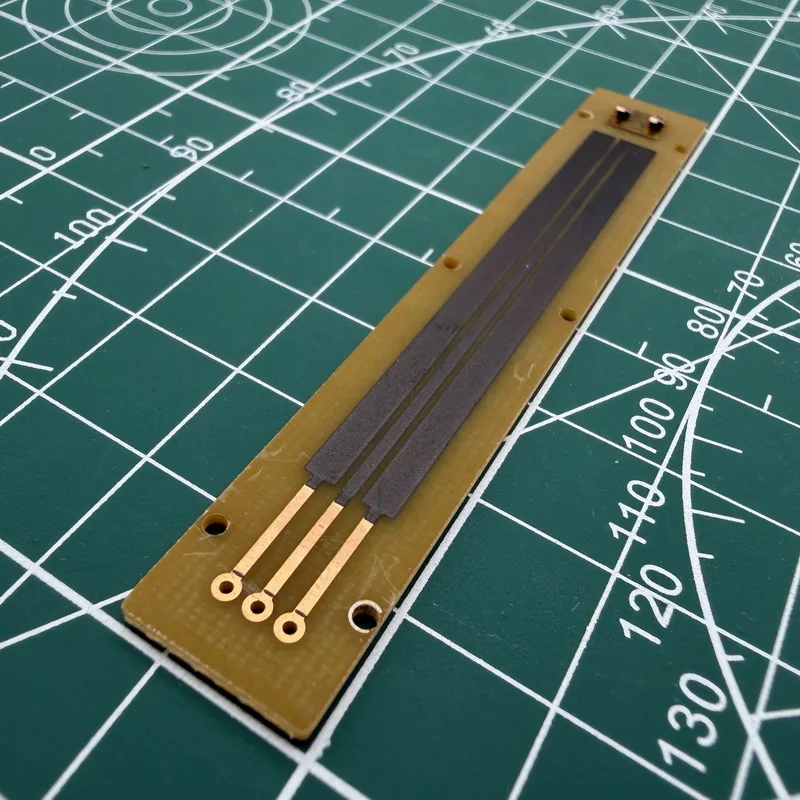
Resistive element used inside a 10 mm miniature contact-type angle sensor. The circular track, wiper contact area, and three terminal pads show why very small angle sensors need enough internal space for stable output and usable life.
Let me first say the key point:
If you decide to use a contact-type angle sensor, please try to reserve a core circular space of 10-15 mm for the angle sensor in the final product. This will directly affect performance and life.
In the next article, I will use some more extreme values of conductive plastic and carbon film to explain why. For now, please remember this value: 10 mm-15 mm. I believe this is not the absolute limit, but commercial products still need to consider cost.
Back to the main topic:
There is some overlap between miniature angle sensors and miniature potentiometers, but their focus is different.
If a product needs to follow a shaft, linkage, valve, pedal, knob, or other moving part continuously, and output a continuous angle change signal, then it is closer to an angle sensor.
A contact-type miniature angle sensor still uses a resistive track and wiper structure.
Its output is usually an analog voltage signal. In essence, it can still be understood based on the voltage divider principle.
Its advantages are:
- Clear and simple structure.
- Easy-to-read signal.
- Relatively controllable cost.
- Better reliability than non-contact types, but relatively shorter life.
For contact-type miniature angle sensors, many engineers focus on “whether it can be made smaller.” The smaller, the better. But what NOL focuses on is:
- How large the effective electrical angle can be.
- Whether the resistive track width is enough.
- Whether the wiper pressure is stable.
- How to handle the dead zone at both ends.
- Output linearity.
Especially when the product outer diameter is compressed to around a dozen millimeters, and the customer still wants an effective electrical angle above 300°, the difficulty increases clearly. At this point, it is not enough to simply draw the resistive track into a circle. We also need to consider end connections, zero-ohm areas, wiper contact width, and the actual manufacturable space.
The customer sees a very small round component. But NOL sees the trade-off between angle, life, linearity, and space.
6. From the manufacturer’s point of view, we care more about how the customer will use it
When a customer brings a concept drawing of a small component and asks for a price, I usually do not look at the resistance value first. In small-volume products, resistance value often becomes something to consider later.
We need to first understand where this product will be used.
If the customer only says “10K, this small,” that information is far from enough.
Because 10K can be a through-hole trimmer, an SMD trimmer, a miniature potentiometer, or even a contact-type miniature angle sensor.
This time, when I organized information based on public brand data and distributor platform classifications, even the photos were sometimes confusing. And if the photos are confusing, that proves many people actually have misunderstandings about the classification of these products.
Final Notes: For small components, first define the use, then discuss the size
Trimmers, miniature potentiometers, and miniature angle sensors all look like small adjustable components. But they do not follow the same purchasing logic.
Trimmers mainly solve circuit calibration problems.
Through-hole and SMD are only different mounting methods.
Miniature potentiometers solve adjustment problems in small spaces.
Miniature angle sensors solve rotary position detection and signal feedback problems.
If you only look at resistance value and size, these product types are easy to mix together.
If you first look at the application, their boundaries become much clearer.
At NOLELC, we are more used to starting from the customer’s actual usage, and then deciding which manufacturing route the product should follow. For customers who need alternatives to high-spec models from Bourns, Vishay, Novotechnik, and similar brands, we do not judge the product based on a single data point. Instead, we evaluate mounting method, effective angle, life, output stability, and batch manufacturing feasibility together.
This may make the early communication a little longer, and some customers may even become impatient. But for customers who truly need small- or medium-batch customized products, our method is usually safer and closer to the real problem they need to solve.