Skip to content

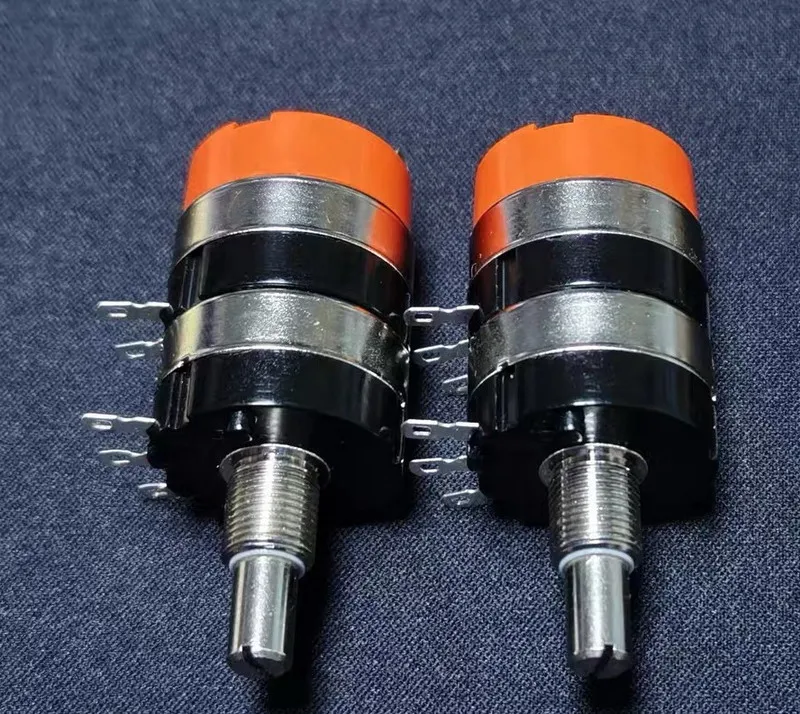
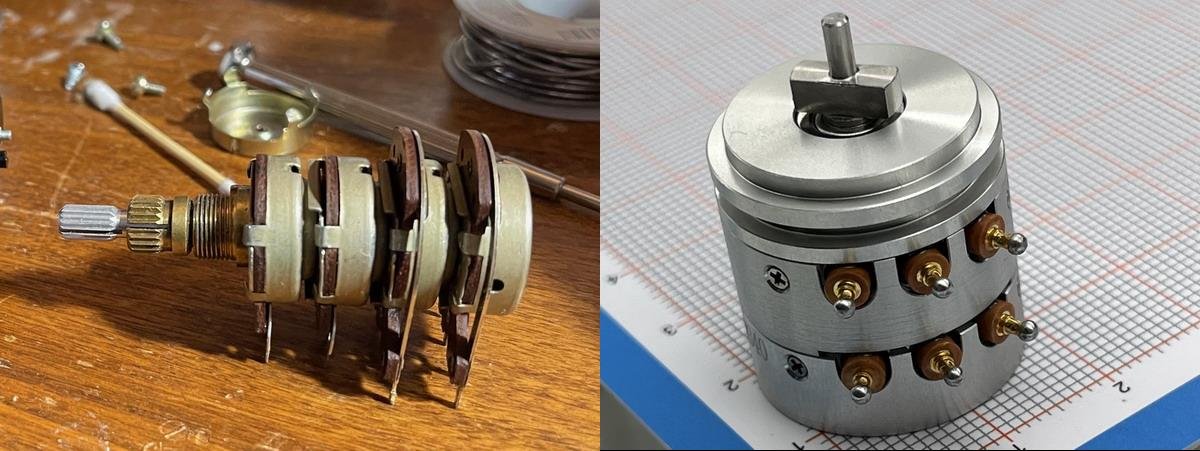
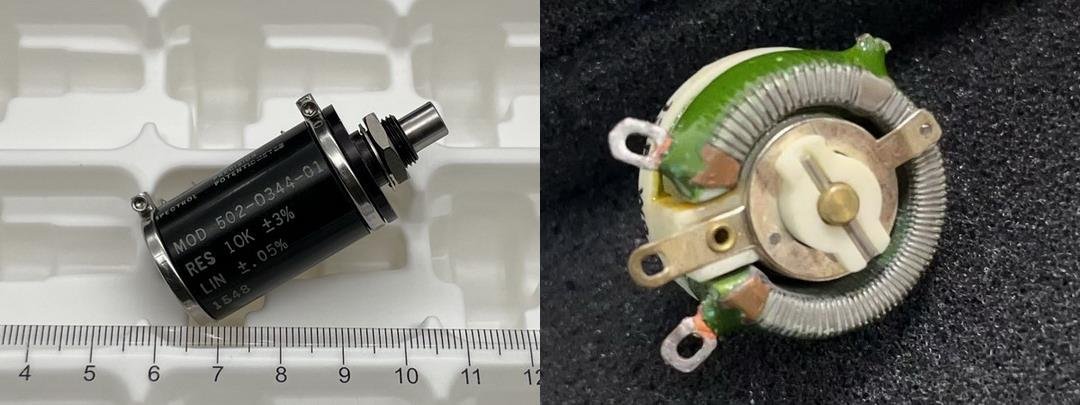
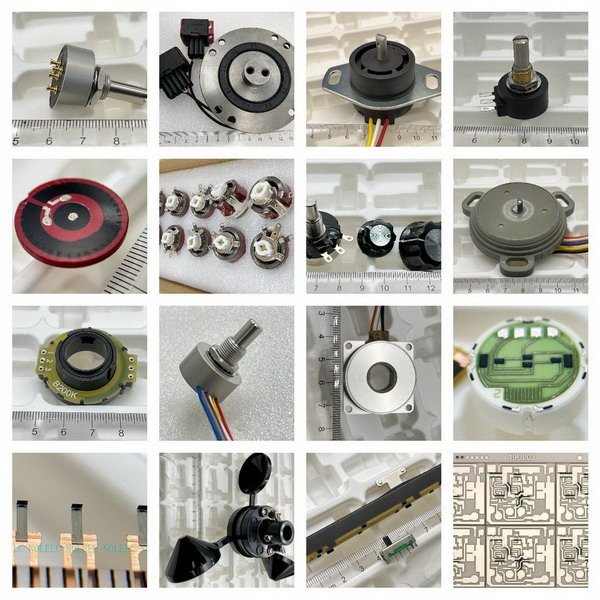
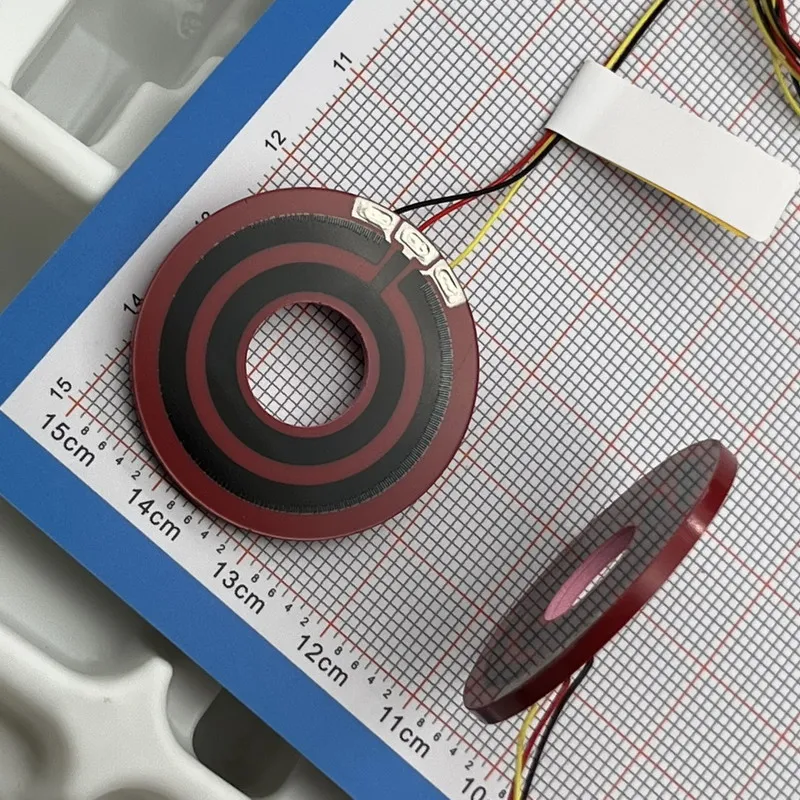
The image shows a standard dual-wiper, dual-track conductive plastic potentiometer resistive element.
Introduction: A Real Question from Research and Test Users
Among our customers, in addition to application-driven industrial users, there are also many universities and research institutions.
As end users, they often prefer sensor solutions with the simplest possible structure, so that installation, debugging, and secondary development can be carried out easily in a laboratory environment.
In long-term communication, we repeatedly encounter a question that involves both technical reasoning and cost considerations:
Why is a dual-wiper and dual-track resistive structure used?
If the goal is only structural simplification and ease of installation, could a single-wiper design with a single conductive plastic track be sufficient?
This question is intuitive and reflects a genuine user demand.
It is precisely because this question has been raised repeatedly that this article was written—to explain why conductive plastic potentiometers (sensors) commonly adopt a dual-track and dual-wiper structure.
We aim to explain the reasons behind this design choice from the perspective of real-world usage.
1. Why “Simpler” Is Not Necessarily More Reliable in Real Applications
From a structural standpoint, a single-wiper design combined with a single conductive plastic track can indeed provide a continuous position signal.
In laboratory environments, such solutions often appear feasible, with simple wiring, intuitive installation, and low debugging costs.
However, in real applications, the issue is rarely whether a signal can be generated, but whether that signal remains stable, repeatable, and accurate under vibration, temperature variation, and long-term operation.
These factors may not be obvious during short-term testing, but they tend to amplify over time and ultimately affect measurement accuracy and system reliability.
2. The True Purpose of Dual-Track and Dual-Wiper Design: Functional Separation
In mature conductive plastic displacement sensor designs, the primary purpose of a dual-track structure is not to add complexity, but to achieve functional separation.
The conductive plastic track is used for position-related signal sensing, focusing on resistance continuity and linearity.
The metal track (such as a silver track) provides a stable electrical reference and current path, focusing on contact stability and low contact resistance.
With a dual-wiper design, signal sampling and current conduction are clearly separated, each fulfilling a distinct engineering role.
This structural separation significantly improves signal stability, noise performance, and long-term consistency.
2.1 Comparison Table
To better illustrate the differences between the two designs in practical use, the following table provides a comparison based on engineering performance:
| Comparison Aspect | Single-Wiper + Single-Track | Dual-Wiper + Dual-Track |
|---|---|---|
| Structural Intuition | Simpler | More complex |
| Laboratory Installation | More intuitive | Requires understanding of functional separation |
| Signal Stability | Easily affected by contact conditions | More stable |
| Contact Resistance Variation (CRV) | Relatively high | Significantly reduced |
| Vibration Resistance | Weaker | Better |
| Current Path Stability | Easily coupled with signal | Signal and current path separated |
| Long-Term Repeatability | Degrades over time | More consistent |
| Lifetime Controllability | Strongly affected by contact state | Easier to achieve long service life |
| Application Suitability | Low-demand or demonstration use | Industrial and long-term use |
From a practical standpoint, when signal sensing and current conduction are combined into a single contact point (a single-wiper, single-track design), issues such as contact resistance variation, sensitivity to vibration, and unstable current paths are more likely to occur.
These issues may not cause immediate failure, but they directly affect signal noise, repeatability, and measurement accuracy.
For this reason, in applications with clear requirements for precision, stability, and service life, single-wiper designs are gradually being replaced by more mature dual-wiper solutions.
3. A Mature Design Example: Learning from a Classic Product
In many mature products, the dual-track structure is not an exception but a widely accepted design validated through long-term engineering practice.
A representative example is the 6915 model from TE Connectivity’s 69XX series.
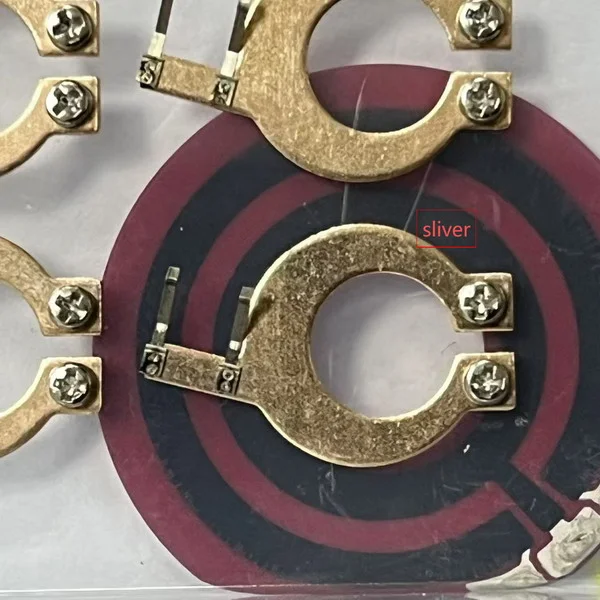
In the TE 6915 structure, two concentric conductive tracks can be clearly observed.
The outer track is a conductive plastic resistive element for position-related signal output.
The inner continuous circular track is actually made of silver, serving as a stable electrical reference and current path—although many users mistakenly assume it is also conductive plastic.
In NOL’s actual manufacturing, this design philosophy is applied to both rotary conductive plastic potentiometers and linear displacement sensors.
This concept itself is not new; it originates from structural choices validated over time by mature manufacturers such as TE and Novotechnik.
Rather than reinventing a completely different solution, we focus on reproducing, manufacturing, and implementing these proven design principles in real applications.
As a result, NOL can meet customer expectations consistently across products with different motion forms.
4. Dual-Track Design in Linear Motion: Why It Matters Even More
In addition to rotary structures, conductive plastic sensors used in linear displacement applications also commonly adopt dual-track and dual-wiper designs.

This is a linear motion schematic I previously drew for an institute.
Although it looks a bit rough, it still conveys the working principle clearly.
Compared to rotary designs, linear displacement sensors typically have longer travel, unidirectional motion, and continuously changing relative positions between the slider and lead wires.
Under such conditions, the electrical circuit state is more susceptible to change during movement, directly affecting signal output.
In linear structures, the wiring logic itself is not complex, but functional responsibilities are clearly separated.
Because circuit stability is more sensitive in linear motion, combining signal sensing and current conduction into a single contact tends to amplify instability over long-term use.
5. Slider Support Components: Structure, Lifetime, and Delivery Considerations
In dual-wiper contact structures, the slider support component is another frequently discussed element.
This is because the contacts typically use an array of precious-metal wire wipers.
Such a wiper structure is essential for fully utilizing the performance of conductive plastic tracks and achieving service lives on the order of tens of millions of cycles.

From a delivery standpoint, multi-wire precious-metal wipers are relatively vulnerable during logistics and transportation.
The slider support not only serves as a functional component during operation but also provides fixation and protection during shipment.
The purpose of this structure is not to increase part count, but to balance service life, operational reliability, and delivery safety.
6. Final Note
In displacement sensor design, the hardest question is not whether measurement is possible, but whether it can be performed reliably, repeatedly, and stably over long-term real-world use.
From the perspective of laboratory convenience, simplifying structures is understandable.
However, in real applications and mass production, mature designs are often not the ones that look simplest.
Once the design principles are clear, the real differentiator is not the concept itself, but the ability to manufacture these mature designs consistently and reliably.
For customers entering engineering validation or mass production, structural consistency, batch stability, and manufacturing control are critical for long-term cooperation.
If your project is looking for a supplier with mature technical understanding and manufacturing capability, NOL would be glad to discuss structural details and long-term cooperation based on your specific application.