Skip to content

Individual Potentiometer Names (Left → Right)
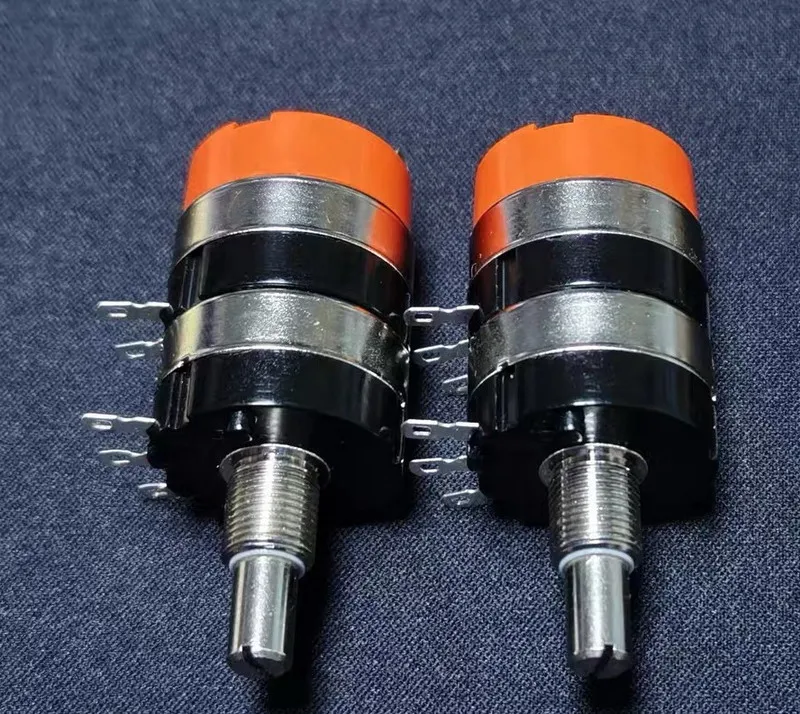
1. Carbon Film Potentiometer (RVQ24YN Series)
Traditional rotary potentiometer using a carbon film resistive layer, widely used in consumer electronics.
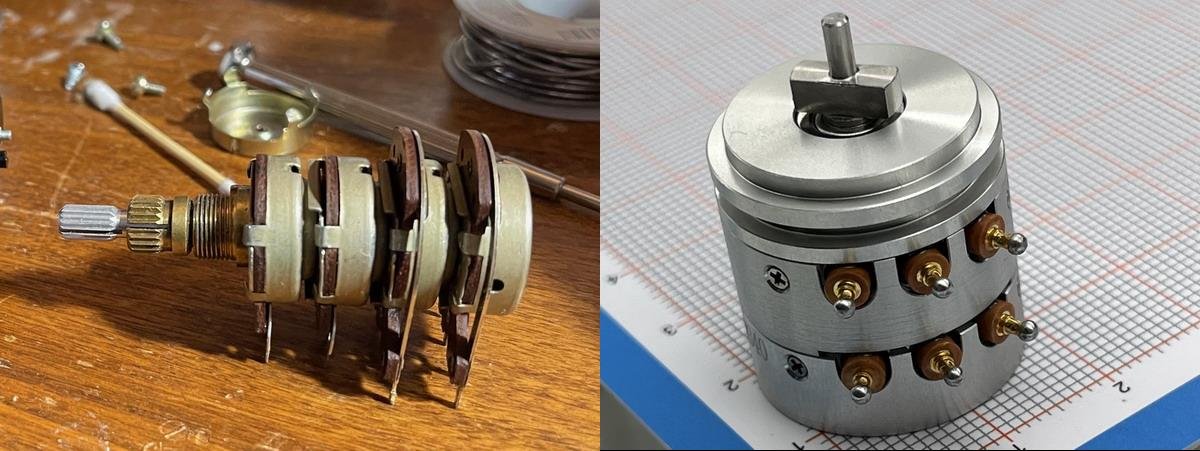
2. Wire-Wound Potentiometer (M22L10 / 3590 Series)
Precision rotary type with resistance wire wound on an insulating core, featuring high accuracy and power handling.
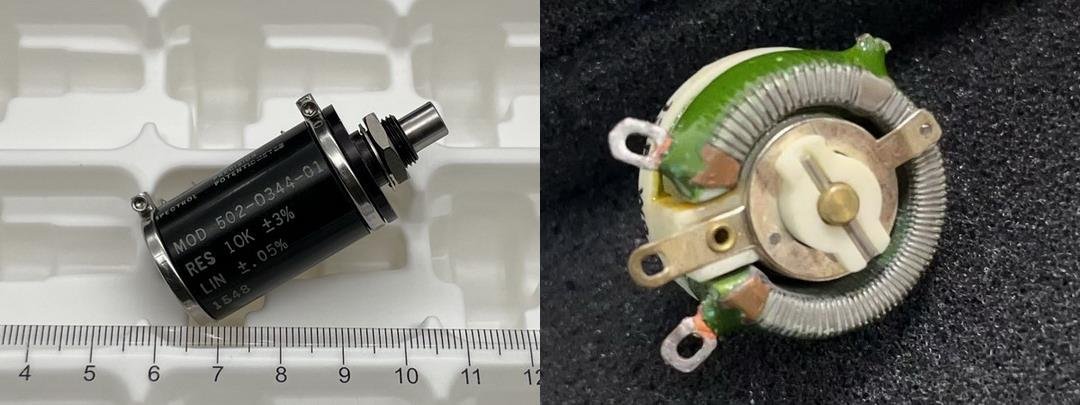
3. SMD Cermet Trimmer Potentiometer (3314 / 3362 Series)
Surface-mounted trimmer with ceramic–metal film technology, designed for fine-tuning voltage and signal calibration on compact PCBs.
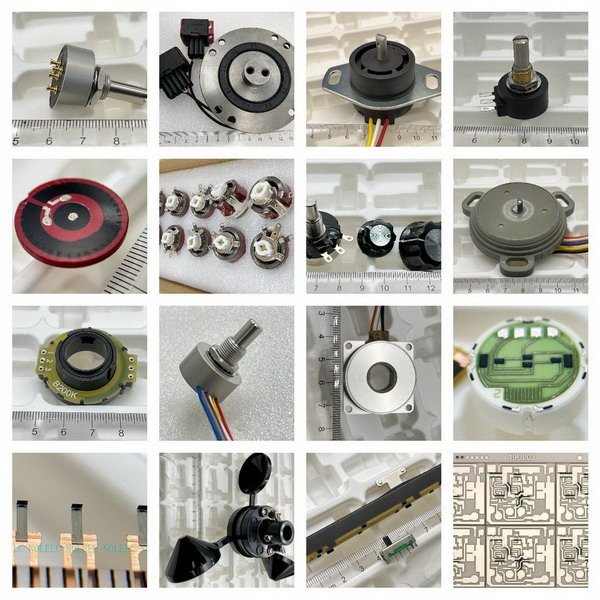
4. Linear Conductive Plastic Potentiometer (TWL / TLH Series)
Rod-type position sensor using conductive plastic resistive elements, providing smooth, precise, and repeatable linear motion feedback for automation systems.
5. Optical Rotary Encoder (CTS291 Series)
Non-contact photoelectric potentiometer replacement, offering high-resolution angular detection and extremely long operational life.
1. Historical Background — 1827 and the Carbon Pile Resistor
Potentiometers have a history of more than a century. Shortly after Ohm’s law was proposed in 1827, scientists began experimenting with adjustable resistors. One early design, the carbon pile resistor, used stacked carbon discs to vary resistance by pressure. Though crude, it represented the earliest prototype of what we now call the potentiometer (variable resistor) — the foundation for all later developments.
2. Early Development — 1920s to 1940s
The 1920s saw the rapid expansion of radio and other electronic equipment based on vacuum tubes. This era demanded reliable control of voltage and current, leading to the birth of wire-wound potentiometers and early synthetic carbon film types.
Wire-wound potentiometers, wound with fine resistance wire around an insulating base, offered exceptional accuracy and heat tolerance, making them ideal for analog computing and instrumentation.
By the 1940s, engineers developed precision potentiometers with improved linearity — a key step toward modern control systems.
3. The Transistor Era — 1950s
The 1950s ushered in the transistor age, transforming how electronic circuits were designed. Since transistor circuits amplified current instead of voltage, potentiometers needed lower resistance and minimal contact noise. This era also saw miniaturization, as consumer electronics required smaller, quieter, and more reliable components.
4. The Film Age — Carbon and Cermet Technologies (1950s–1970s)
As transistors replaced vacuum tubes, carbon-film potentiometers became the mainstream choice for radios, televisions, and household electronics — inexpensive but prone to wear and electrical noise.
For higher-end and military equipment, cermet (ceramic–metal) potentiometers offered superior stability, linearity, and temperature resistance. These innovations bridged the gap between wire-wound designs and the coming plastic revolution.
5. The Conductive Plastic Revolution — 1960s–Present
In the 1960s, the United States introduced conductive plastic potentiometers, soon followed by similar developments in the U.K. and Japan. This polymer technology delivers smooth motion, low friction, and very long life, enabling millions of adjustment cycles with minimal noise.
Today, conductive plastic is the preferred choice for motion/position sensing and long-life feedback applications (rotary and linear sensors). Cermet remains widely used—especially in SMD trimmer potentiometers where compact size, stability and re-adjustability on PCBs are required.
6. Evolution Of Potentiometer Materials
| Era | Material Type | Main Features | Typical Period | Typical Applications |
|---|---|---|---|---|
| Carbon Pile | Stacked carbon discs controlled by pressure | Simple and crude, first adjustable resistor in history | 1880s–1900s | Laboratory experiments |
| Wire-Wound Potentiometer | Resistance wire wound on insulating base | High precision, high power, large size | 1930s–1950s | Analog computers, vacuum-tube radios |
| Carbon Film Potentiometer | Carbon film printed on substrate | Low cost, higher noise, shorter life | 1950s–1970s | Radios, TVs, consumer electronics |
| Cermet Potentiometer | Ceramic–metal composite resistive layer | High stability, good linearity, heat resistant; compact SMD formats common | 1950s–Present | SMD trimmer potentiometers, industrial & military instruments |
| Conductive Plastic Potentiometer | Polymer film with conductive particles | Long life, smooth operation, very low noise | 1960s–Present | Rotary/linear position sensors, industrial automation, automotive systems |
7. Summary
From carbon piles to conductive plastics, the evolution of potentiometers mirrors the progress of modern electronics itself. Each generation brought better stability, smoother motion, and longer life, transforming a simple resistor into today’s intelligent motion sensor.